
Pranav Doshi
Global supply chains across aerospace, defence, aviation and mobility are undergoing a major transformation. Driven by geopolitical shifts, post-pandemic disruptions, rising defence budgets and rapid technological change, industries are restructuring how and where manufacturing takes place. Production is no longer concentrated in a few regions; instead, it is becoming globally distributed while remaining highly interconnected. This shift is redefining how manufacturers, suppliers and technology providers collaborate across borders.
Over the past decade, global supply chains have evolved from centralized production models into distributed manufacturing networks. In aerospace, aircraft production is increasing again after pandemic slowdowns, forcing manufacturers to strengthen and diversify their supplier base. Defence programs are expanding across Europe, North America and Asia as governments increase investments in security and advanced technologies. At the same time, the automotive industry is undergoing a historic transition toward electrification, autonomous driving and connected mobility systems.
These industries rely on vast networks of suppliers. OEMs depend on Tier-1, Tier-2 and Tier-3 suppliers providing everything from precision components and electronics to software, advanced materials and maintenance services. However, as supply chains become more global, it has become increasingly difficult for companies particularly smaller suppliers to connect directly with procurement teams and enter international supply networks.
At the same time, new industrial hubs are emerging around the world. While traditional centres such as Seattle, Toulouse and Hamburg remain critical to aerospace manufacturing, countries such as Spain, Italy, Morocco, Tunisia, India, Mexico and Türkiye are becoming important parts of global supply chains. These regions offer specialized manufacturing capabilities, engineering talent and competitive production environments, making them attractive partners for global manufacturers.
The space sector is also becoming a major driver of supply chain expansion. The rapid growth of satellite programs, launch services and space-based data systems is creating demand for advanced components, electronics, materials and software solutions. This is opening new opportunities for technology companies and specialized suppliers to enter the global space ecosystem.
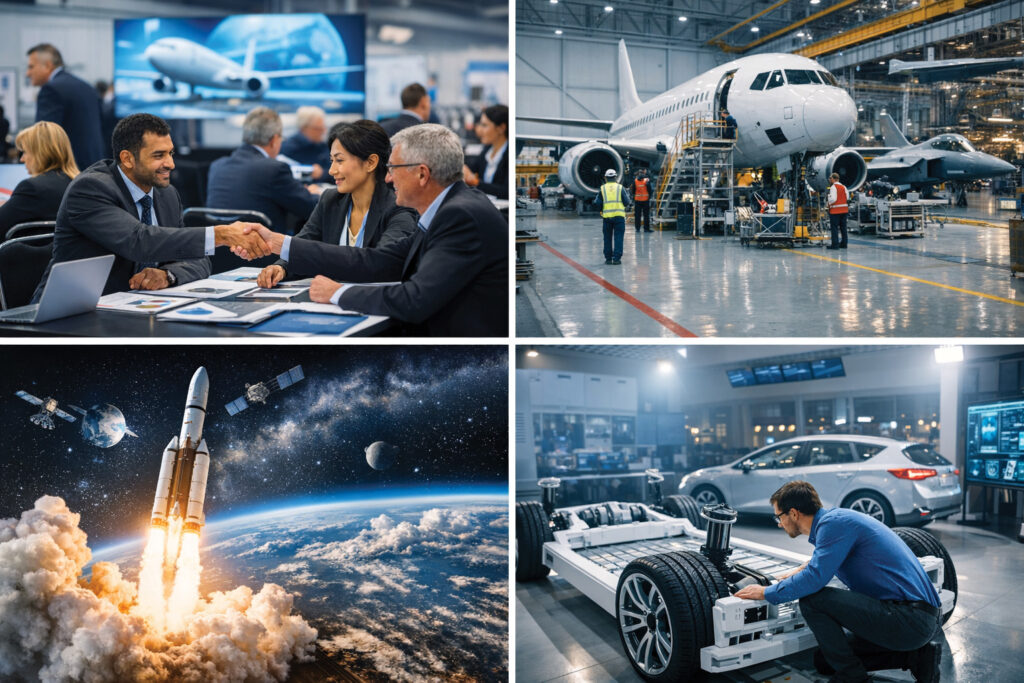
Another fast-growing segment is aviation maintenance, repair and overhaul (MRO). As global aircraft fleets expand, airlines and defence operators require reliable partners for long-term maintenance and lifecycle support. Asia and India, in particular, are emerging as important MRO hubs due to growing aviation markets and strong engineering capabilities.
In this complex and rapidly evolving environment, structured B2B industry platforms are becoming essential tools for supply chain development. By organizing targeted meetings between buyers, suppliers and technology companies, these platforms help companies build partnerships, identify new suppliers and explore new markets. For suppliers, this provides direct access to procurement teams. For OEMs, it offers an efficient way to discover new technologies and diversify supplier networks.
As global industries continue to grow and evolve, supply chains will become even more interconnected and technology-driven. Companies that can build strong international partnerships and integrate into global industrial ecosystems will be best positioned for future growth. The rewiring of global supply chains is not just a temporary adjustment it is the foundation of the next era of industrial development.
For more info :
www.advbe.com