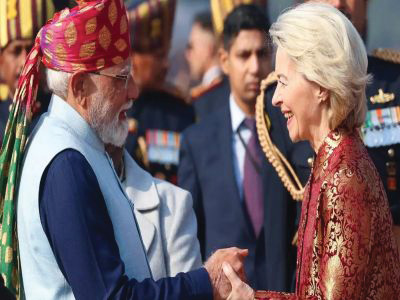
In what is being called a defining moment for global economic cooperation, Prime Minister Narendra Modi has heralded the newly concluded India–European Union Free Trade Agreement (FTA) as the “mother of all deals,” describing it as a strategic milestone that could reshape trade flows and investor confidence across continents. The announcement, made on the sidelines of India Energy Week 2026, signals a fresh chapter in commercial ties between New Delhi and Brussels, and comes at a pivotal moment for the global economy.
Addressing delegates at the marquee energy summit in Goa where representatives from nearly 150 nations gathered Mr. Modi underlined the historic nature of the pact, which brings together markets accounting for nearly 25% of global GDP and roughly one-third of worldwide trade. “This is not just a trade agreement; it is a statement of partnership between two of the world’s largest economies,” he said, spotlighting the collaboration as a template for future economic cooperation.
A Deal Years in the Making
The India–EU FTA, signed on 27 January 2026 after nearly two decades of negotiations, represents India’s most ambitious trade pact to date. It was formally concluded following talks that resumed with renewed momentum in 2022, marking the end of a protracted diplomatic effort to harness deeper economic synergies between South Asia’s fastest-growing major economy and the European bloc.
Under the agreement, tariff barriers on over 90% of goods traded between India and the EU will be either eliminated or significantly reduced, opening European markets to a wide swath of Indian exports from textiles, leather goods and marine products to gems, jewellery and engineering goods. European exporters, in turn, stand to gain from improved access to India’s vast consumer market across sectors ranging from industrial machinery and chemicals to luxury automobiles and pharmaceuticals.
In a move aimed at mutual balance, certain tariffs such as on automobiles and selected agricultural products will be eased on a phased basis, reflecting the careful calibration required to protect sensitive domestic industries while expanding market access.
Beyond Tariffs: Building Economic Bridges
What sets this FTA apart is its multi-dimensional scope. Beyond traditional goods trade, it encompasses enhanced cooperation on services, regulatory convergence, investment protection, intellectual property rights, digital trade frameworks and simplified customs procedures. This broad sweep is designed to foster predictable and inclusive commercial engagement and to lower the cost of doing business for small and medium enterprises from both regions.
“The Free Trade Agreement will boost trade, manufacturing, services and global supply chains,” Modi said, adding that it would help spur domestic manufacturing capabilities and further fortify investor confidence in India’s growth trajectory. He also highlighted how the pact complements India’s recent trade agreements with the United Kingdom and the European Free Trade Association (EFTA).
European Commission President Ursula von der Leyen echoed these sentiments, describing the pact as a major step forward in economic cooperation and a symbol of deepening strategic trust between the EU and India. European Council President António Costa highlighted the demographic and economic scale of the deal, referring to the combined market of some 2 billion people that will benefit from the agreement.
A Pledge for Shared Prosperity
Economic analysts suggest that the FTA could significantly boost bilateral trade, attract investment, and enhance supply-chain resilience at a time when global markets face uncertainty and fragmentation. For Indian industry from apparel and leather to pharmaceuticals and technology the deal opens up new export opportunities while encouraging technology transfer and innovation partnerships. European businesses, meanwhile, gain a more competitive foothold in one of the world’s fastest-expanding markets.
As implementation steps begin, stakeholders across both regions are watching closely, hopeful that this so-called “mother of all deals” will catalyse a more open, interconnected and prosperous era in global trade.